PHolt.1
Senior
August 21, 2024
Solved

32F417 and RDP2: OTP (512 bytes) and SRAM execution

  • August 21, 2024
  • 7 replies
  • 3404 views

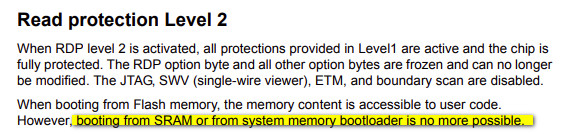
This

suggests that one cannot execute code from SRAM. Is that really correct?

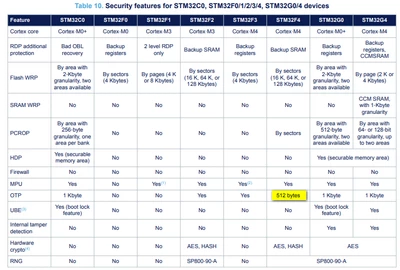
Also there is ambiguity on whether the OTP area (512 bytes plus the control block) is readable in RDP2. Why say "512 bytes" and not just all-OTP?
PHolt1_0-1724234813186.png

The OTP area must remain usable under RDP2 and readable by internal code, but not accessible externally (with a debugger).

Above is from

https://www.st.com/resource/en/application_note/an5156-introduction-to-security-for-stm32-mcus-stmicroelectronics.pdf


Best answer by TDK

No. In RDP2, there's no mechanism to interact with the chip anymore outside of user code. Debug interface is disabled, bootloader can't run.

7 replies

TDK
Super User
August 21, 2024

> suggests that one cannot execute code from SRAM. Is that really correct?

It says that you cannot boot from SRAM, which is accurate. You can still run code from SRAM if that's what your flash program does. OTP is readable by your user program in RDP2.


"If you feel a post has answered your question, please click ""Accept as Solution""."
PHolt.1
PHolt.1Author
Senior
August 21, 2024

What is "booting from RAM"?

At reset, the CPU goes to the table at VTOR and loads SP and PC from that.

Do you mean that the vector table cannot be RAM-based? I know it cannot be in CCM (because you can't execute code from CCM) but that's a different thing.


TDK
Super User
August 21, 2024

> What is "booting from RAM"?

Here are the boot options on the STM32F417:

TDK_0-1724244501613.png

Booting from SRAM is not a typical configuration. 


> Do you mean that the vector table cannot be RAM-based?

No. Hopefully the above table clarifies that.

If you boot from flash, there are no restrictions on placing or executing anything in flash or SRAM.

"If you feel a post has answered your question, please click ""Accept as Solution""."
PHolt.1
PHolt.1Author
Senior
August 21, 2024

Is RDP2, is OTP readable in any way apart from code running internally (RAM or FLASH)?

TDK
TDKBest answer
Super User
August 21, 2024

No. In RDP2, there's no mechanism to interact with the chip anymore outside of user code. Debug interface is disabled, bootloader can't run.

"If you feel a post has answered your question, please click ""Accept as Solution""."
PHolt.1
PHolt.1Author
Senior
August 21, 2024

Q1: Is there any doc on the initial value of the OTP? I would assume 16 x 32 x 0xFF but the RM does not say that AFAICT.

One could set it to say 0x00 and then lock it.

Q2: what is the easiest way for user code to tell if RDP2 is set? Some registers are not readable.

TDK
Super User
August 21, 2024

They're in flash. Erased flash on the STM32F4 is 0xFF. That's certainly in the RM somewhere. The following part of the reference manual lets you infer that 0xFF is the default value, but perhaps it could be more explicit.

TDK_0-1724276929752.png


Read the value, compare it to 0xCC.

TDK_2-1724277035933.png


"If you feel a post has answered your question, please click ""Accept as Solution""."
PHolt.1
PHolt.1Author
Senior
August 21, 2024

Thank you TDK for those super quick and clear replies!

PHolt.1
PHolt.1Author
Senior
August 22, 2024

One more Q:

Is the code for programming the OTP identical to programming the CPU FLASH?

I already have a boot loader which copies itself to RAM and programs the CPU FLASH from there. One has to always do 4 bytes at a time.

There is also lock and unlock, and this is a separate lock and unlock from the OTP ones.

This is the existing code:


/**
 * @brief Locks the FLASH control register access
 * @retval
 */
static void L_HAL_FLASH_Lock(void)
{
	// Wait for any flash operation to finish
	while(__HAL_FLASH_GET_FLAG(FLASH_FLAG_BSY) != RESET);
	// Set the LOCK Bit to lock the FLASH Registers access
	FLASH->CR |= FLASH_CR_LOCK;
}


/**
 * @brief Unlock the FLASH control register access
 * Issues the unlok codes
 */

static void L_HAL_FLASH_Unlock(void)
{
	// Wait for any flash operation to finish
	while(__HAL_FLASH_GET_FLAG(FLASH_FLAG_BSY) != RESET);
	// Write the two unlock codes
	WRITE_REG(FLASH->KEYR, FLASH_KEY1);
	WRITE_REG(FLASH->KEYR, FLASH_KEY2);
}


/**
 * @brief Program word (32-bit) at a specified address.
 * @note This function must be used when the device voltage range is from
 * 2.7V to 3.6V.
 *
 * @note If an erase and a program operations are requested simultaneously,
 * the erase operation is performed before the program one.
 *
 * @PAram Address specifies the address to be programmed.
 * @PAram Data specifies the data to be programmed.
 * @retval None
 * Waits for previous operation to finish
 *
 */

static void L_FLASH_Program_Word(uint32_t Address, uint32_t Data)
{
	// wait for any previous op to finish
	while(__HAL_FLASH_GET_FLAG(FLASH_FLAG_BSY) != RESET);
	// clear program size bits
	CLEAR_BIT(FLASH->CR, FLASH_CR_PSIZE);
	// reload program size bits
	FLASH->CR |= FLASH_PSIZE_WORD;
	// enable programming
	FLASH->CR |= FLASH_CR_PG;
	// write the data in
	*(volatile uint32_t*)Address = Data;
}

TDK
Super User
August 22, 2024

> Is the code for programming the OTP identical to programming the CPU FLASH?

I believe so. Just with the caveat that it can never be erased, and the addition of the lock byte functionality. If you want to modify less than 32 bits, you can set the other bits to 1 and they won't change as programming flash can only change a bit from 1 -> 0.

"If you feel a post has answered your question, please click ""Accept as Solution""."
PHolt.1
PHolt.1Author
Senior
August 22, 2024

My reading of the RM text is that you can write the OTP area as much as you like (IOW it is identical to other CPU FLASH) and it becomes non-writable only when the lock byte(s) get set.

But you cannot - even before the locks are set - erase any of it i.e. apply an erase command. Once a bit is 0 you cannot make it 1.

The code I posted above does not do any erase because I am using the block erase (block being 16k to 128k acocrding to where) beforehand.