WWang.15
Associate II
January 15, 2025
Solved

About the radio frequency parameters and distance of WL33.

  • January 15, 2025
  • 2 replies
  • 3791 views

Dear ST experts.

We are a module manufacturer. We have designed a module based on WL33. We have been using ST's dk board for verification. However, when we tested the distance, the original dk board was about 200 meters. With a 20dbm and -12X sensitivity, we have high expectations for this chip. Do you have ST distance test reports and parameters?
2. If our deviation is <2.5Khz, does it mean that we need to replace the TCXO?


B.R. Weili Wang.

Best answer by Saverio GRUTTA

Hello Weili,

We started to analyze your problem. First, we checked the sensitivity in conducted mode with the same radio configuration to verify the receiver's performance. The value we measured is -106 dBm, which is in line with our expectations. Then, we tested our kit in radiated mode using the same antenna we provide with the board and measured a noise floor close to what you measured, in the range between -110 to -105 dBm. Considering an SNR of around 8 dB, we expect to start losing packets with an RSSI close to -100 dBm. Indeed, the plot below shows that we start to lose packets with power lower than -97 dBm. This is coherent to me. I would expect to see the same behavior in your side, but you started to lose packets at -84 dBm, which is far from both the noise floor and sensitivity.

Noise floor
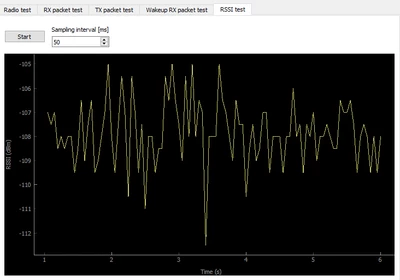
SaverioGRUTTA_1-1737040096591.png


Packet received at -97 dBm

SaverioGRUTTA_0-1737040058064.png

We can consider a link budget of around 115 dB. Using the two-ray model as the mathematical model, the expected range of communication should be around 900 meters.

Regarding the transmitter, the correct settings are TX mode = TX HP and SMPS = 1.5V.

Could you repeat the test at a different frequency to verify if the problem is caused by an interferer ?

Best regards

Saverio Grutta

2 replies

Saverio GRUTTA
ST Employee
January 15, 2025

Hello

In order to understand better the cause of this behaviour I need to have more details on the RF parameters  used (TX power, data rate, frequency deviation and channel filter).

Consider that the max power our kit can deliver is 16 dBm. To reach 20 dBm is necessary a BOM change.

Are you using one kit as transmitter and a second kit as receiver.

Regards

Saverio Grutta

WWang.15
WWang.15Author
Associate II
January 16, 2025

Hi Saverio.

We use STM32WL33 original dk board for both TX and RX.
I just asked our engineer, we set a power supply voltage in the GUI,
Then the tx power is measured by spectrum and is about 18-19dbm@CW

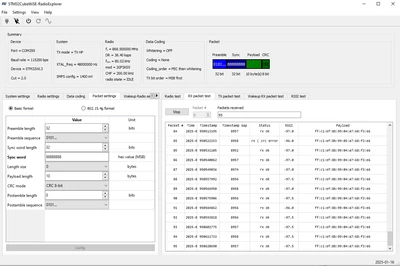
RF parameter as below.

WWang15_3-1736997895330.png


background noise as below.

WWang15_0-1736997713553.png

WWang15_1-1736997755209.png

the distance about 160M,

Sent 100 packets and received about 10 packets.

WWang15_2-1736997830217.png


could you give me some suggestions?

Thx.


Saverio GRUTTA
Saverio GRUTTABest answer
ST Employee
January 16, 2025

Hello Weili,

We started to analyze your problem. First, we checked the sensitivity in conducted mode with the same radio configuration to verify the receiver's performance. The value we measured is -106 dBm, which is in line with our expectations. Then, we tested our kit in radiated mode using the same antenna we provide with the board and measured a noise floor close to what you measured, in the range between -110 to -105 dBm. Considering an SNR of around 8 dB, we expect to start losing packets with an RSSI close to -100 dBm. Indeed, the plot below shows that we start to lose packets with power lower than -97 dBm. This is coherent to me. I would expect to see the same behavior in your side, but you started to lose packets at -84 dBm, which is far from both the noise floor and sensitivity.

Noise floor

SaverioGRUTTA_1-1737040096591.png


Packet received at -97 dBm

SaverioGRUTTA_0-1737040058064.png

We can consider a link budget of around 115 dB. Using the two-ray model as the mathematical model, the expected range of communication should be around 900 meters.

Regarding the transmitter, the correct settings are TX mode = TX HP and SMPS = 1.5V.

Could you repeat the test at a different frequency to verify if the problem is caused by an interferer ?

Best regards

Saverio Grutta

Saverio GRUTTA
ST Employee
January 28, 2025

Hello Weili,

Yes, It is the Spread Factor.  

Regards

Saverio