Question
STM32WB55RG BLE HardFault error
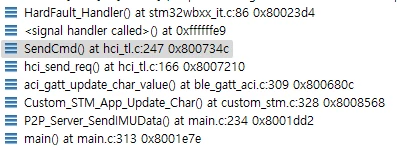
Hi. I bought the ble_p2pServer example code on an stm32 wb55rg board and am trying to get ble communication. The example code was imported via stm32 cubemx. The current problem is that I am getting a HardFault error in the SendCmd function in the hci_tl.c code. Specifically, the error occurs on line 8 where it calls pCmdBuffer.
static void SendCmd(uint16_t opcode, uint8_t plen, void *param) {

	if (pCmdBuffer == NULL) {
		printf("error");
	}

	pCmdBuffer->cmdserial.cmd.cmdcode = opcode;
	pCmdBuffer->cmdserial.cmd.plen = plen;

	memcpy(pCmdBuffer->cmdserial.cmd.payload, param, plen);

	hciContext.io.Send(0, 0);

	return;
}
My complete main.c code is shown below.
/* USER CODE BEGIN Header */
/**
 ******************************************************************************
 * @file : main.c
 * @brief : Main program body
 ******************************************************************************
 * @attention
 *
 * Copyright (c) 2024 STMicroelectronics.
 * All rights reserved.
 *
 * This software is licensed under terms that can be found in the LICENSE file
 * in the root directory of this software component.
 * If no LICENSE file comes with this software, it is provided AS-IS.
 *
 ******************************************************************************
 */
/* USER CODE END Header */
/* Includes ------------------------------------------------------------------*/
#include "main.h"

/* Private includes ----------------------------------------------------------*/
/* USER CODE BEGIN Includes */
#include "custom_stm.h"
/* USER CODE END Includes */

/* Private typedef -----------------------------------------------------------*/
/* USER CODE BEGIN PTD */
#define LSM9DS1_ADDR (0x6A << 1)
#define MAG_ADDR 	 (0x1E << 1)

#define WHO_AM_I_REG 0x0F

#define CTRL_REG1_G 0x10
//#define CTRL_REG1_G 0x20

#define CTRL_REG5_XL 0x1F
#define CTRL_REG6_XL 0x20

#define CTRL_REG1_M 0x20
#define CTRL_REG3_M 0x22
#define CTRL_REG4_G 0x1E
#define CTRL_REG7_G 0x16
#define CTRL_REG8 0x22
#define CTRL_REG9 0x23
//#define FIFO_CTRL 0x2E

#define OUT_X_G 0x18
#define OUT_X_XL 0x28
#define OUT_X_M 0x28

#define OUT_X_L_G 0x18
#define OUT_X_H_G 0x19
#define OUT_Y_L_G 0x1A
#define OUT_Y_H_G 0x1B
#define OUT_Z_L_G 0x1C
#define OUT_Z_H_G 0x1D

#define GYRO_SENSITIVITY_245DPS 8.75f
#define ACCEL_SENSITIVITY_2G 16384.0f
#define MAG_SENSITIVITY_4GAUSS 6842.0f

#define betaDef 0.5f
/* USER CODE END PTD */

/* Private define ------------------------------------------------------------*/
/* USER CODE BEGIN PD */

/* USER CODE END PD */

/* Private macro -------------------------------------------------------------*/
/* USER CODE BEGIN PM */

/* USER CODE END PM */

/* Private variables ---------------------------------------------------------*/
I2C_HandleTypeDef hi2c1;

IPCC_HandleTypeDef hipcc;

RTC_HandleTypeDef hrtc;

/* USER CODE BEGIN PV */
uint8_t gyro_status;

int16_t gyroX, gyroY, gyroZ;
int16_t accelX, accelY, accelZ;
int16_t magX, magY, magZ;

float accel_x, accel_y, accel_z;
float gyro_x, gyro_y, gyro_z;
float mag_x, mag_y, mag_z;

static uint8_t imu_data_buffer[12];

float ax1, ay1, az1, gx1, gy1, gz1, mx1, my1, mz1, mx2, my2, mz2;
volatile float beta = betaDef;
volatile float q0 = 1.0f, q1 = 0.0f, q2 = 0.0f, q3 = 0.0f;

float test_flag = 0;

/* USER CODE END PV */

/* Private function prototypes -----------------------------------------------*/
void SystemClock_Config(void);
void PeriphCommonClock_Config(void);
static void MX_GPIO_Init(void);
static void MX_I2C1_Init(void);
static void MX_IPCC_Init(void);
static void MX_RTC_Init(void);
static void MX_RF_Init(void);
/* USER CODE BEGIN PFP */

/* USER CODE END PFP */

/* Private user code ---------------------------------------------------------*/
/* USER CODE BEGIN 0 */
uint8_t LSM9DS1_ReadRegister(uint8_t addr, uint8_t reg) {
	uint8_t value;
	HAL_I2C_Mem_Read(&hi2c1, addr, reg, I2C_MEMADD_SIZE_8BIT, &value, 1,
	HAL_MAX_DELAY);
	return value;
}

void LSM9DS1_WriteRegister(uint8_t addr, uint8_t reg, uint8_t value) {
	HAL_I2C_Mem_Write(&hi2c1, addr, reg, I2C_MEMADD_SIZE_8BIT, &value, 1,
	HAL_MAX_DELAY);
}

void LSM9DS1_Init() {
	//gyro reset
	LSM9DS1_WriteRegister(LSM9DS1_ADDR, CTRL_REG8, 0x05);
	HAL_Delay(50);

	//gyro setting
	LSM9DS1_WriteRegister(LSM9DS1_ADDR, CTRL_REG1_G, 0xA0);
	HAL_Delay(50);

	LSM9DS1_WriteRegister(LSM9DS1_ADDR, CTRL_REG4_G, 0x38);
	HAL_Delay(50);

	LSM9DS1_WriteRegister(LSM9DS1_ADDR, CTRL_REG9, 0x02);
	HAL_Delay(50);

	//accel setting
	LSM9DS1_WriteRegister(LSM9DS1_ADDR, CTRL_REG6_XL, 0x20);
	HAL_Delay(50);

	//mag setting
	LSM9DS1_WriteRegister(MAG_ADDR, CTRL_REG1_M, 0x70);
	HAL_Delay(50);

	LSM9DS1_WriteRegister(MAG_ADDR, CTRL_REG3_M, 0x00);
}

void LSM9DS1_ReadGyro() {
	uint8_t buffer[6];

	if (HAL_I2C_Mem_Read(&hi2c1, LSM9DS1_ADDR, OUT_X_G | 0x80,
	I2C_MEMADD_SIZE_8BIT, buffer, 6, HAL_MAX_DELAY) == HAL_OK) {
		gyroX = (int16_t) ((buffer[1] << | buffer[0]);
		gyroY = (int16_t) ((buffer[3] << | buffer[2]);
		gyroZ = (int16_t) ((buffer[5] << | buffer[4]);

		gyro_x = gyroX * GYRO_SENSITIVITY_245DPS / 1000.0f;
		gyro_y = gyroY * GYRO_SENSITIVITY_245DPS / 1000.0f;
		gyro_z = gyroZ * GYRO_SENSITIVITY_245DPS / 1000.0f - 4.6;

	} else {
		gyroX = gyroY = gyroZ = 0;
	}
}

void LSM9DS1_ReadAccel() {
	uint8_t buffer[6];

	if (HAL_I2C_Mem_Read(&hi2c1, LSM9DS1_ADDR, OUT_X_XL | 0x80,
	I2C_MEMADD_SIZE_8BIT, buffer, 6, HAL_MAX_DELAY) == HAL_OK) {
		accelX = (int16_t) ((buffer[1] << | buffer[0]);
		accelY = (int16_t) ((buffer[3] << | buffer[2]);
		accelZ = (int16_t) ((buffer[5] << | buffer[4]);

		accel_x = accelX / ACCEL_SENSITIVITY_2G * 10;
		accel_y = accelY / ACCEL_SENSITIVITY_2G * 10;
		accel_z = accelZ / ACCEL_SENSITIVITY_2G * 10;
	} else {
		accelX = accelY = accelZ = 0;
	}
}

void LSM9DS1_ReadMag() {
	uint8_t buffer[6];

	if (HAL_I2C_Mem_Read(&hi2c1, MAG_ADDR, OUT_X_M | 0x80, I2C_MEMADD_SIZE_8BIT,
			buffer, 6, HAL_MAX_DELAY) == HAL_OK) {
		magX = (int16_t) ((buffer[1] << | buffer[0]);
		magY = (int16_t) ((buffer[3] << | buffer[2]);
		magZ = (int16_t) ((buffer[5] << | buffer[4]);

		mag_x = magX / MAG_SENSITIVITY_4GAUSS;
		mag_y = magY / MAG_SENSITIVITY_4GAUSS;
		mag_z = magZ / MAG_SENSITIVITY_4GAUSS;

	} else {
		magX = magY = magZ = 0;
	}
}

void P2P_Server_SendIMUData() {
//	tBleStatus result;

// IMU ?��?��?�� 버퍼?�� �? ???��
	imu_data_buffer[0] = (uint8_t) (accel_x * 1000) >> 8;
	imu_data_buffer[1] = (uint8_t) (accel_x * 1000) & 0xFF;
	imu_data_buffer[2] = (uint8_t) (accel_y * 1000) >> 8;
	imu_data_buffer[3] = (uint8_t) (accel_y * 1000) & 0xFF;
	imu_data_buffer[4] = (uint8_t) (accel_z * 1000) >> 8;
	imu_data_buffer[5] = (uint8_t) (accel_z * 1000) & 0xFF;

	imu_data_buffer[6] = (uint8_t) (gyro_x * 1000) >> 8;
	imu_data_buffer[7] = (uint8_t) (gyro_x * 1000) & 0xFF;
	imu_data_buffer[8] = (uint8_t) (gyro_y * 1000) >> 8;
	imu_data_buffer[9] = (uint8_t) (gyro_y * 1000) & 0xFF;
	imu_data_buffer[10] = (uint8_t) (gyro_z * 1000) >> 8;
	imu_data_buffer[11] = (uint8_t) (gyro_z * 1000) & 0xFF;

	imu_data_buffer[12] = (uint8_t) (mag_x * 1000) >> 8;
	imu_data_buffer[13] = (uint8_t) (mag_x * 1000) & 0xFF;
	imu_data_buffer[14] = (uint8_t) (mag_y * 1000) >> 8;
	imu_data_buffer[15] = (uint8_t) (mag_y * 1000) & 0xFF;
	imu_data_buffer[16] = (uint8_t) (mag_z * 1000) >> 8;
	imu_data_buffer[17] = (uint8_t) (mag_z * 1000) & 0xFF;

	tBleStatus ret = Custom_STM_App_Update_Char(CUSTOM_STM_MYCHARWRITE,
			imu_data_buffer);

	if (ret != BLE_STATUS_SUCCESS) {
		test_flag = test_flag + 1;
		printf("Failed to send IMU data over BLE, error code: 0x%x\n", ret);
	}

//	result = P2PS_STM_App_Update_Char(P2P_NOTIFY_CHAR_UUID, imu_data_buffer,
//			sizeof(imu_data_buffer));
//
//	if (result != BLE_STATUS_SUCCESS) {
//		printf("Failed to send IMU data over BLE, error code: %d\n", result);
//	}
}
/* USER CODE END 0 */

/**
 * @brief The application entry point.
 * @retval int
 */
int main(void) {

	/* USER CODE BEGIN 1 */

	/* USER CODE END 1 */

	/* MCU Configuration--------------------------------------------------------*/

	/* Reset of all peripherals, Initializes the Flash interface and the Systick. */
	HAL_Init();
	/* Config code for STM32_WPAN (HSE Tuning must be done before system clock configuration) */
	MX_APPE_Config();

	/* USER CODE BEGIN Init */

	/* USER CODE END Init */

	/* Configure the system clock */
	SystemClock_Config();

	/* Configure the peripherals common clocks */
	PeriphCommonClock_Config();

	/* IPCC initialisation */
	MX_IPCC_Init();

	/* USER CODE BEGIN SysInit */

	/* USER CODE END SysInit */

	/* Initialize all configured peripherals */
	MX_GPIO_Init();
	MX_I2C1_Init();
	MX_RTC_Init();
	MX_RF_Init();
	/* USER CODE BEGIN 2 */

	/* USER CODE END 2 */

	/* Init code for STM32_WPAN */
	MX_APPE_Init();

	/* Infinite loop */
	/* USER CODE BEGIN WHILE */
	LSM9DS1_Init();
	HAL_Delay(50);

	while (1) {

		LSM9DS1_ReadGyro();
//		HAL_Delay(10);

		LSM9DS1_ReadAccel();
//		HAL_Delay(10);

		LSM9DS1_ReadMag();
//		HAL_Delay(10);

		P2P_Server_SendIMUData();
		HAL_Delay(10);

		/* USER CODE END WHILE */
		MX_APPE_Process();

		/* USER CODE BEGIN 3 */
	}
	/* USER CODE END 3 */
}

/**
 * @brief System Clock Configuration
 * @retval None
 */
void SystemClock_Config(void) {
	RCC_OscInitTypeDef RCC_OscInitStruct = { 0 };
	RCC_ClkInitTypeDef RCC_ClkInitStruct = { 0 };

	/** Configure LSE Drive Capability
	 */
	HAL_PWR_EnableBkUpAccess();
	__HAL_RCC_LSEDRIVE_CONFIG(RCC_LSEDRIVE_MEDIUMHIGH);

	/** Configure the main internal regulator output voltage
	 */
	__HAL_PWR_VOLTAGESCALING_CONFIG(PWR_REGULATOR_VOLTAGE_SCALE1);

	/** Initializes the RCC Oscillators according to the specified parameters
	 * in the RCC_OscInitTypeDef structure.
	 */
	RCC_OscInitStruct.OscillatorType = RCC_OSCILLATORTYPE_HSI
			| RCC_OSCILLATORTYPE_HSE | RCC_OSCILLATORTYPE_LSE
			| RCC_OSCILLATORTYPE_MSI;
	RCC_OscInitStruct.HSEState = RCC_HSE_ON;
	RCC_OscInitStruct.LSEState = RCC_LSE_ON;
	RCC_OscInitStruct.HSIState = RCC_HSI_ON;
	RCC_OscInitStruct.MSIState = RCC_MSI_ON;
	RCC_OscInitStruct.HSICalibrationValue = RCC_HSICALIBRATION_DEFAULT;
	RCC_OscInitStruct.MSICalibrationValue = RCC_MSICALIBRATION_DEFAULT;
	RCC_OscInitStruct.MSIClockRange = RCC_MSIRANGE_10;
	RCC_OscInitStruct.PLL.PLLState = RCC_PLL_NONE;
	if (HAL_RCC_OscConfig(&RCC_OscInitStruct) != HAL_OK) {
		Error_Handler();
	}

	/** Configure the SYSCLKSource, HCLK, PCLK1 and PCLK2 clocks dividers
	 */
	RCC_ClkInitStruct.ClockType = RCC_CLOCKTYPE_HCLK4 | RCC_CLOCKTYPE_HCLK2
			| RCC_CLOCKTYPE_HCLK | RCC_CLOCKTYPE_SYSCLK | RCC_CLOCKTYPE_PCLK1
			| RCC_CLOCKTYPE_PCLK2;
	RCC_ClkInitStruct.SYSCLKSource = RCC_SYSCLKSOURCE_MSI;
	RCC_ClkInitStruct.AHBCLKDivider = RCC_SYSCLK_DIV1;
	RCC_ClkInitStruct.APB1CLKDivider = RCC_HCLK_DIV1;
	RCC_ClkInitStruct.APB2CLKDivider = RCC_HCLK_DIV1;
	RCC_ClkInitStruct.AHBCLK2Divider = RCC_SYSCLK_DIV1;
	RCC_ClkInitStruct.AHBCLK4Divider = RCC_SYSCLK_DIV1;

	if (HAL_RCC_ClockConfig(&RCC_ClkInitStruct, FLASH_LATENCY_1) != HAL_OK) {
		Error_Handler();
	}
}

/**
 * @brief Peripherals Common Clock Configuration
 * @retval None
 */
void PeriphCommonClock_Config(void) {
	RCC_PeriphCLKInitTypeDef PeriphClkInitStruct = { 0 };

	/** Initializes the peripherals clock
	 */
	PeriphClkInitStruct.PeriphClockSelection = RCC_PERIPHCLK_SMPS
			| RCC_PERIPHCLK_RFWAKEUP;
	PeriphClkInitStruct.RFWakeUpClockSelection = RCC_RFWKPCLKSOURCE_LSE;
	PeriphClkInitStruct.SmpsClockSelection = RCC_SMPSCLKSOURCE_HSI;
	PeriphClkInitStruct.SmpsDivSelection = RCC_SMPSCLKDIV_RANGE0;

	if (HAL_RCCEx_PeriphCLKConfig(&PeriphClkInitStruct) != HAL_OK) {
		Error_Handler();
	}
	/* USER CODE BEGIN Smps */

	/* USER CODE END Smps */
}

/**
 * @brief I2C1 Initialization Function
 * None
 * @retval None
 */
static void MX_I2C1_Init(void) {

	/* USER CODE BEGIN I2C1_Init 0 */

	/* USER CODE END I2C1_Init 0 */

	/* USER CODE BEGIN I2C1_Init 1 */

	/* USER CODE END I2C1_Init 1 */
	hi2c1.Instance = I2C1;
	hi2c1.Init.Timing = 0x00B07CB4;
	hi2c1.Init.OwnAddress1 = 0;
	hi2c1.Init.AddressingMode = I2C_ADDRESSINGMODE_7BIT;
	hi2c1.Init.DualAddressMode = I2C_DUALADDRESS_DISABLE;
	hi2c1.Init.OwnAddress2 = 0;
	hi2c1.Init.OwnAddress2Masks = I2C_OA2_NOMASK;
	hi2c1.Init.GeneralCallMode = I2C_GENERALCALL_DISABLE;
	hi2c1.Init.NoStretchMode = I2C_NOSTRETCH_DISABLE;
	if (HAL_I2C_Init(&hi2c1) != HAL_OK) {
		Error_Handler();
	}

	/** Configure Analogue filter
	 */
	if (HAL_I2CEx_ConfigAnalogFilter(&hi2c1, I2C_ANALOGFILTER_ENABLE)
			!= HAL_OK) {
		Error_Handler();
	}

	/** Configure Digital filter
	 */
	if (HAL_I2CEx_ConfigDigitalFilter(&hi2c1, 0) != HAL_OK) {
		Error_Handler();
	}
	/* USER CODE BEGIN I2C1_Init 2 */

	/* USER CODE END I2C1_Init 2 */

}

/**
 * @brief IPCC Initialization Function
 * None
 * @retval None
 */
static void MX_IPCC_Init(void) {

	/* USER CODE BEGIN IPCC_Init 0 */

	/* USER CODE END IPCC_Init 0 */

	/* USER CODE BEGIN IPCC_Init 1 */

	/* USER CODE END IPCC_Init 1 */
	hipcc.Instance = IPCC;
	if (HAL_IPCC_Init(&hipcc) != HAL_OK) {
		Error_Handler();
	}
	/* USER CODE BEGIN IPCC_Init 2 */

	/* USER CODE END IPCC_Init 2 */

}

/**
 * @brief RF Initialization Function
 * None
 * @retval None
 */
static void MX_RF_Init(void) {

	/* USER CODE BEGIN RF_Init 0 */

	/* USER CODE END RF_Init 0 */

	/* USER CODE BEGIN RF_Init 1 */

	/* USER CODE END RF_Init 1 */
	/* USER CODE BEGIN RF_Init 2 */

	/* USER CODE END RF_Init 2 */

}

/**
 * @brief RTC Initialization Function
 * None
 * @retval None
 */
static void MX_RTC_Init(void) {

	/* USER CODE BEGIN RTC_Init 0 */

	/* USER CODE END RTC_Init 0 */

	/* USER CODE BEGIN RTC_Init 1 */

	/* USER CODE END RTC_Init 1 */

	/** Initialize RTC Only
	 */
	hrtc.Instance = RTC;
	hrtc.Init.HourFormat = RTC_HOURFORMAT_24;
	hrtc.Init.AsynchPrediv = CFG_RTC_ASYNCH_PRESCALER;
	hrtc.Init.SynchPrediv = CFG_RTC_SYNCH_PRESCALER;
	hrtc.Init.OutPut = RTC_OUTPUT_DISABLE;
	hrtc.Init.OutPutPolarity = RTC_OUTPUT_POLARITY_HIGH;
	hrtc.Init.OutPutType = RTC_OUTPUT_TYPE_OPENDRAIN;
	hrtc.Init.OutPutRemap = RTC_OUTPUT_REMAP_NONE;
	if (HAL_RTC_Init(&hrtc) != HAL_OK) {
		Error_Handler();
	}

	/** Enable the WakeUp
	 */
	if (HAL_RTCEx_SetWakeUpTimer_IT(&hrtc, 0, RTC_WAKEUPCLOCK_RTCCLK_DIV16)
			!= HAL_OK) {
		Error_Handler();
	}
	/* USER CODE BEGIN RTC_Init 2 */

	/* USER CODE END RTC_Init 2 */

}

/**
 * @brief GPIO Initialization Function
 * None
 * @retval None
 */
static void MX_GPIO_Init(void) {
	GPIO_InitTypeDef GPIO_InitStruct = { 0 };
	/* USER CODE BEGIN MX_GPIO_Init_1 */
	/* USER CODE END MX_GPIO_Init_1 */

	/* GPIO Ports Clock Enable */
	__HAL_RCC_GPIOC_CLK_ENABLE();
	__HAL_RCC_GPIOB_CLK_ENABLE();
	__HAL_RCC_GPIOA_CLK_ENABLE();
	__HAL_RCC_GPIOD_CLK_ENABLE();

	/*Configure GPIO pin Output Level */
	HAL_GPIO_WritePin(GPIOA, GPIO_PIN_6 | GPIO_PIN_7, GPIO_PIN_RESET);

	/*Configure GPIO pin Output Level */
	HAL_GPIO_WritePin(GPIOB, LD2_Pin | LD3_Pin | LD1_Pin, GPIO_PIN_RESET);

	/*Configure GPIO pins : PA6 PA7 */
	GPIO_InitStruct.Pin = GPIO_PIN_6 | GPIO_PIN_7;
	GPIO_InitStruct.Mode = GPIO_MODE_OUTPUT_PP;
	GPIO_InitStruct.Pull = GPIO_NOPULL;
	GPIO_InitStruct.Speed = GPIO_SPEED_FREQ_LOW;
	HAL_GPIO_Init(GPIOA, &GPIO_InitStruct);

	/*Configure GPIO pin : B1_Pin */
	GPIO_InitStruct.Pin = B1_Pin;
	GPIO_InitStruct.Mode = GPIO_MODE_INPUT;
	GPIO_InitStruct.Pull = GPIO_PULLUP;
	HAL_GPIO_Init(B1_GPIO_Port, &GPIO_InitStruct);

	/*Configure GPIO pins : LD2_Pin LD3_Pin LD1_Pin */
	GPIO_InitStruct.Pin = LD2_Pin | LD3_Pin | LD1_Pin;
	GPIO_InitStruct.Mode = GPIO_MODE_OUTPUT_PP;
	GPIO_InitStruct.Pull = GPIO_NOPULL;
	GPIO_InitStruct.Speed = GPIO_SPEED_FREQ_LOW;
	HAL_GPIO_Init(GPIOB, &GPIO_InitStruct);

	/*Configure GPIO pins : USB_DM_Pin USB_DP_Pin */
	GPIO_InitStruct.Pin = USB_DM_Pin | USB_DP_Pin;
	GPIO_InitStruct.Mode = GPIO_MODE_AF_PP;
	GPIO_InitStruct.Pull = GPIO_NOPULL;
	GPIO_InitStruct.Speed = GPIO_SPEED_FREQ_LOW;
	GPIO_InitStruct.Alternate = GPIO_AF10_USB;
	HAL_GPIO_Init(GPIOA, &GPIO_InitStruct);

	/*Configure GPIO pins : B2_Pin B3_Pin */
	GPIO_InitStruct.Pin = B2_Pin | B3_Pin;
	GPIO_InitStruct.Mode = GPIO_MODE_INPUT;
	GPIO_InitStruct.Pull = GPIO_NOPULL;
	HAL_GPIO_Init(GPIOD, &GPIO_InitStruct);

	/*Configure GPIO pins : STLINK_RX_Pin STLINK_TX_Pin */
	GPIO_InitStruct.Pin = STLINK_RX_Pin | STLINK_TX_Pin;
	GPIO_InitStruct.Mode = GPIO_MODE_AF_PP;
	GPIO_InitStruct.Pull = GPIO_NOPULL;
	GPIO_InitStruct.Speed = GPIO_SPEED_FREQ_LOW;
	GPIO_InitStruct.Alternate = GPIO_AF7_USART1;
	HAL_GPIO_Init(GPIOB, &GPIO_InitStruct);

	/* USER CODE BEGIN MX_GPIO_Init_2 */
	/* USER CODE END MX_GPIO_Init_2 */
}

/* USER CODE BEGIN 4 */

/* USER CODE END 4 */

/**
 * @brief This function is executed in case of error occurrence.
 * @retval None
 */
void Error_Handler(void) {
	/* USER CODE BEGIN Error_Handler_Debug */
	/* User can add his own implementation to report the HAL error return state */
	__disable_irq();
	while (1) {
	}
	/* USER CODE END Error_Handler_Debug */
}

#ifdef USE_FULL_ASSERT
/**
 * @brief Reports the name of the source file and the source line number
 * where the assert_param error has occurred.
 * file: pointer to the source file name
 * line: assert_param error line source number
 * @retval None
 */
void assert_failed(uint8_t *file, uint32_t line)
{
 /* USER CODE BEGIN 6 */
 /* User can add his own implementation to report the file name and line number,
 ex: printf("Wrong parameters value: file %s on line %d\r\n", file, line) */
 /* USER CODE END 6 */
}
#endif /* USE_FULL_ASSERT */
The debug output from the stm32 cubeIDE is shown below.